
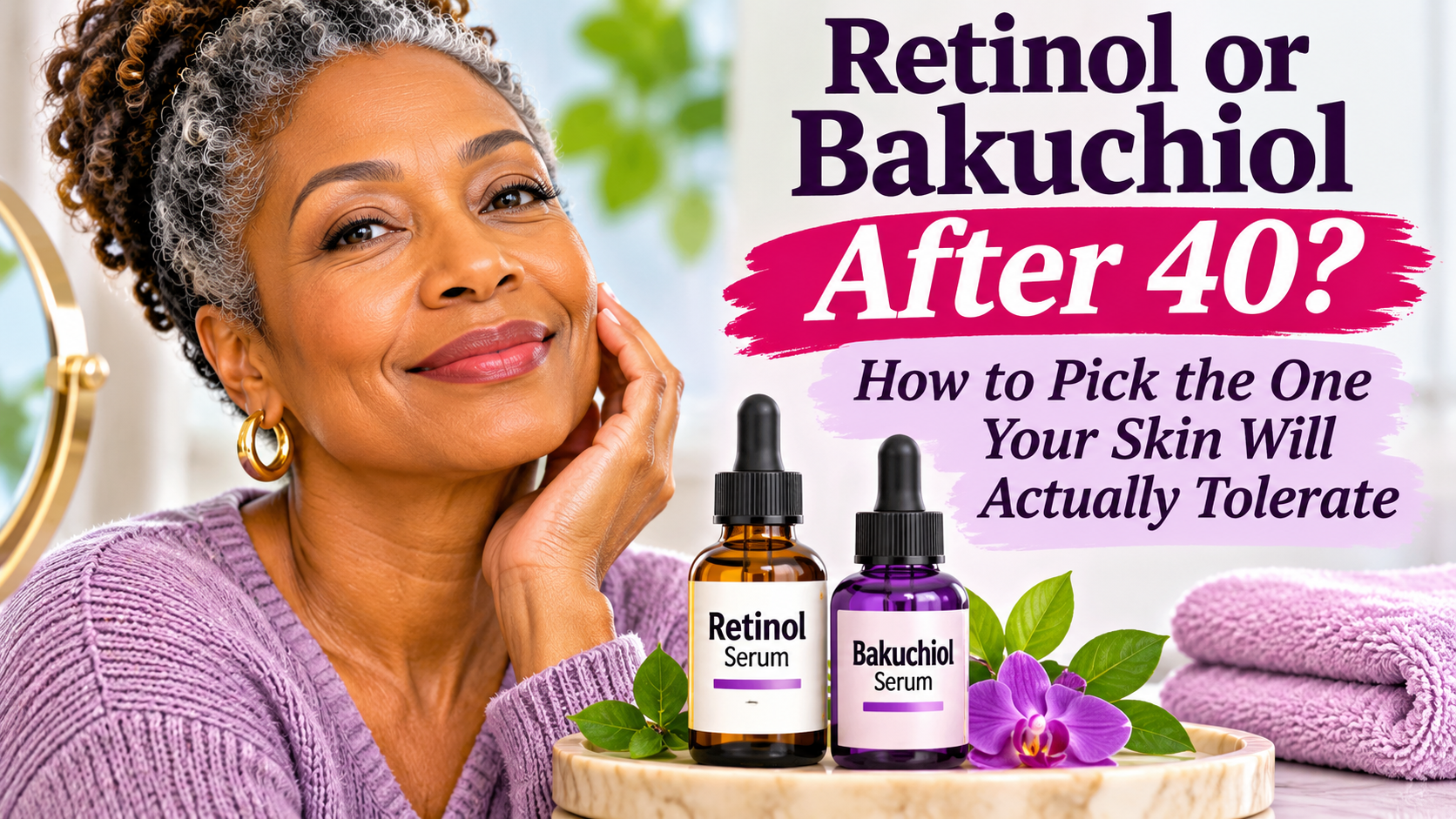
You want smoother skin and fewer visible fine lines. But you don’t want your face peeling, burning, or turning red just to get there.
So which should you choose: retinol or bakuchiol?
Let’s compare the research, the irritation risk, and what actually makes sense for your skin.

If you’re over 40, you’ve probably noticed that your skin doesn’t always tolerate products the way it used to.
Maybe the moisturizer you loved at 30 suddenly isn’t enough.
Maybe your face feels dry, your fine lines are more noticeable, or your skin reacts to products that never bothered you before.
And when you start researching anti-aging skincare, two ingredients keep showing up.
Retinol and bakuchiol.
One has decades of research behind the broader retinoid family.
The other is a plant-derived ingredient that has attracted attention as a potentially gentler alternative.
But which one should you actually put on your face?
That’s what we’re going to figure out.
Retinol is generally the better-established option for fine lines, uneven texture, and certain pigmentation concerns. Bakuchiol may be worth considering if you’re sensitive to retinol, but its research base is smaller. Neither ingredient is automatically right for everyone.
1. Retinol and Bakuchiol in Plain English
What Is Retinol?
Retinol is a form of vitamin A belonging to the retinoid family.
When applied to skin, it undergoes conversion steps that ultimately produce retinoic acid, which influences skin-cell activity.
Retinoids are used to address concerns such as fine lines, uneven pigmentation, acne, and rough texture.
But here’s the catch.
Retinol can cause dryness, peeling, stinging, and irritation, especially when you first start using it.
That’s why jumping straight into a strong formula isn’t always the smartest move.
What Is Bakuchiol?
Bakuchiol is a plant-derived compound associated with the babchi plant.
It’s often marketed as a natural retinol alternative.
But bakuchiol is not vitamin A, and it is not technically a retinoid.
Some research suggests it may improve the appearance of fine lines and uneven pigmentation.
It may also cause less irritation than retinol in certain formulations.
However, being plant-derived does not automatically make it safe for every skin type.
Retinol
Think: A well-established vitamin A skincare ingredient with meaningful evidence, but a greater potential for irritation.
Bakuchiol
Think: A promising plant-derived alternative that may be gentler, but has less extensive clinical research.
2. What the Research Actually Says
Let’s talk about the evidence without getting buried in scientific language.
A small randomized, double-blind study published in the British Journal of Dermatology compared bakuchiol with retinol for facial photoaging.
The study included 44 participants over 12 weeks.
Researchers compared:
- Bakuchiol 0.5% applied twice daily.
- Retinol 0.5% applied once daily.
Both groups showed improvements in measures of fine wrinkles and hyperpigmentation.
There was no statistically significant difference between the groups for those outcomes.
But the retinol group reported more scaling and stinging.
That sounds like a win for bakuchiol, right?
Not so fast.
The study was relatively small, lasted only 12 weeks, and tested specific formulations and application schedules.
It doesn’t prove that every bakuchiol serum performs as well as every retinol product.
It also doesn’t establish how the two compare over years of use.
Our takeaway: Bakuchiol has promising evidence for some signs of photoaging, while retinoids have a much larger overall body of research.
Read the published retinol-versus-bakuchiol clinical trial .
3. Why Mature Skin Can React Differently
After 40, and especially during and after menopause, your skin may undergo changes that affect how it feels and responds to products.
Some women notice:
- Increased dryness.
- More visible fine lines.
- Changes in elasticity.
- Greater sensitivity.
- Slower recovery from irritation.
- More noticeable uneven pigmentation.
Declining estrogen can contribute to changes in skin hydration, thickness, and collagen.
But everyone’s skin is different.
Some women in their 50s tolerate retinol beautifully.
Others find even a mild formula irritating.
And that’s why age alone shouldn’t determine which product you buy.

Don’t Ignore Your Skin Barrier
Your skin barrier helps keep moisture in and irritants out.
When that barrier is compromised, strong active ingredients can make irritation worse.
If your face already feels tight, flaky, burning, or unusually sensitive, focus on gentle cleansing and moisturizing before introducing retinol or bakuchiol.
And if you have persistent redness or rosacea, consult a dermatologist before experimenting with anti-aging actives.
4. Retinol vs. Bakuchiol: The Side-by-Side Comparison
| What Matters | Retinol | Bakuchiol |
|---|---|---|
| Fine lines | Better-established evidence | Promising, smaller studies |
| Uneven texture | Can improve texture over time | May improve texture |
| Dark spots | Can help some pigmentation concerns | Early evidence of benefit |
| Irritation | Dryness, peeling, and stinging are common | May be better tolerated, but can still irritate |
| Time to results | Usually several weeks to months | Changes studied over approximately 12 weeks |
| Sun precautions | Use at night and protect skin from the sun | Daily sunscreen is still essential |
| Pregnancy | Avoid retinoids | Insufficient safety data; seek medical advice |
| Research depth | Substantial research across retinoids | Smaller and less extensive evidence base |
One thing worth remembering: retinol does not necessarily work faster just because it is stronger or more irritating.
Consistency and tolerability matter.
5. Which One Fits Your Skin?
Here’s a practical way to decide.
Consider a low-strength retinol in a moisturizing formula or a simple bakuchiol product. Focus on barrier support first. Neither ingredient should be added to actively irritated skin.
Bakuchiol may be a reasonable starting point because some research suggests better tolerability. Patch testing is still necessary.
Don’t assume bakuchiol is automatically safe. Get redness and inflammation under control and ask a dermatologist which actives are appropriate.
Retinol may be the better choice if your skin tolerates it and you can use it consistently.
Either ingredient may cause irritation. Because inflammation can lead to dark marks, introduce products slowly and avoid aggressive application.
Choose one product rather than stacking several active serums. Simplicity makes it easier to identify what helps or irritates your skin.
And if you’re already happy with your skin?
You don’t have to use either one.
A gentle cleanser, moisturizer, and sunscreen are a perfectly reasonable skincare foundation.
6. How to Start Without Wrecking Your Skin Barrier
Here’s where a lot of women get into trouble.
They buy a new serum, use it every single night, and then wonder why their face feels like sandpaper.
More isn’t always better.
A Gentle Retinol Starter Plan
Test a small area according to the product instructions. Stop if significant irritation develops.
If tolerated, try a low-strength retinol one or two nights weekly. Apply to dry skin and follow with moisturizer.
If your skin is comfortable, you may gradually increase frequency. If dryness or stinging develops, reduce use or stop.
Look for gradual improvements in texture and fine lines. Don’t expect dramatic changes overnight.
How to Start Bakuchiol
Bakuchiol may be easier to tolerate, but you should still start cautiously.
- Patch test first.
- Begin with one application every few days.
- Follow the product’s directions.
- Increase use only if your skin remains comfortable.
- Stop if you experience persistent burning, rash, or irritation.
Remember that the frequency used in a clinical trial isn’t necessarily the best starting schedule for your skin.
What About the Moisturizer Sandwich?
Some people find retinol easier to tolerate when they apply moisturizer before and after it.
This is often called the moisturizer sandwich.
It may help reduce irritation, although the best application method depends on the product and your skin.
Always follow the manufacturer’s directions or your dermatologist’s instructions.
7. Can You Use Retinol and Bakuchiol Together?
Yes, some skincare products combine them.
But that doesn’t mean everyone needs both.
There’s limited evidence that layering separate retinol and bakuchiol products provides better results than using one well-formulated product.
And using multiple active ingredients may increase irritation.
If you’re new to either ingredient, start with one.
Give your skin time to adjust.
Then decide whether you actually need anything else.
A Simple Evening Routine
Retinol Night
Gentle cleanser, low-strength retinol according to directions, and moisturizer.
Recovery Night
Gentle cleanser and moisturizer. Skip strong exfoliants and unnecessary active treatments.
If you choose bakuchiol instead, follow its product directions and maintain the same gentle skincare foundation.
For help building a complete routine, visit:
The Ultimate Guide to Anti-Aging Skincare Routines .
8. What to Look for on the Label Without Wasting Money
Before buying a serum, take a look at the actual formula.
Don’t let pretty packaging make the decision for you.
For Retinol
- Look for a beginner-friendly formula.
- Choose moisturizing ingredients such as glycerin or ceramides.
- Avoid starting with the highest concentration available.
- Consider packaging that limits air and light exposure.
- Check whether the formula also contains exfoliating acids.
For Bakuchiol
- Check whether bakuchiol is clearly listed in the ingredients.
- Don’t assume every product labeled “bio-retinol” contains bakuchiol.
- Look for a formula suited to your skin type.
- Avoid unnecessary fragrance if your skin is sensitive.
- Don’t assume a higher percentage automatically means better results.
Also compare the price per ounce rather than judging value by the size of the bottle.
And remember: expensive doesn’t automatically mean more effective.
For a broader guide to skincare shopping, read:
Best Anti-Aging Products for Mature Skin: Expert Guide .
Our Retinol and Bakuchiol Shopping Shortlist
If you’re ready to compare products, start with these two options.
These are shopping options, not guarantees of results. Check the complete ingredient lists and confirm which formula suits your skin.
Explore a Retinol Serum
Potential fit: Someone who wants a more established anti-aging ingredient and whose skin can tolerate a retinoid.
Before buying, check the retinol concentration, moisturizing ingredients, fragrance, and application instructions.
View Retinol Option on AmazonAmazon affiliate link. Product identity and formula should be confirmed before publication.
Explore a Bakuchiol Serum
Potential fit: Someone who wants to explore a potentially gentler alternative and understands that the evidence is still developing.
Before buying, check the bakuchiol ingredient listing, fragrance, additional active ingredients, and product directions.
View Bakuchiol Option on AmazonAmazon affiliate link. Product identity and formula should be confirmed before publication.
As an Amazon Associate I earn from qualifying purchases. Some links in this article are affiliate links, meaning Beauty Never Fades may receive a commission if you purchase through them, at no additional cost to you.
Frequently Asked Questions
Is bakuchiol as effective as retinol?
One small 12-week trial found similar improvements in certain photoaging measures, but more research is needed before treating them as universally equivalent.
Is bakuchiol safe for rosacea?
Not necessarily. It may be gentler in some formulations, but rosacea-prone skin can react to many ingredients. Consult a dermatologist before trying new active treatments.
Can I use retinol every night after 50?
Some people tolerate nightly use, but beginners should start slowly and increase only as tolerated. Follow product directions.
Can I use bakuchiol while pregnant?
There isn’t enough reliable pregnancy-safety research to assume topical bakuchiol is safe. Discuss it with your obstetric healthcare professional. Retinoids should be avoided during pregnancy.
Do I still need sunscreen with bakuchiol?
Yes. Daily broad-spectrum SPF 30 or higher is important regardless of which anti-aging ingredient you choose.
How long before I see results?
Expect gradual changes over several weeks or months. Results depend on the product, your skin, and consistency.
The Bottom Line: Pick What Your Skin Can Live With
Retinol has a stronger overall research foundation.
Bakuchiol has promising evidence and may be easier for some people to tolerate.
But the best product isn’t necessarily the strongest, newest, or most expensive one.
It’s the one that addresses your concern without repeatedly irritating your skin.
If you’re dealing with dry or sensitive skin, start cautiously.
If you’re looking for a more established treatment and your skin tolerates retinol, that may be a reasonable choice.
And if your skin is already irritated, focus on repairing your routine before adding more active ingredients.
Because healthy, comfortable skin is always more important than chasing somebody else’s definition of looking younger.
That’s what Beauty Never Fades is all about.
Ready to Choose Your First Serum?
Review the retinol and bakuchiol options above, compare the ingredients, and choose the approach that best suits your skin and budget.
Patch test before applying a new product to your entire face. If you have rosacea, persistent irritation, or a medical skin condition, check with a dermatologist first.
Explore Retinol on Amazon Explore Bakuchiol on AmazonAffiliate links. We may earn a commission from qualifying purchases.

Sources and Further Reading
- British Journal of Dermatology: Clinical Comparison of Bakuchiol and Retinol
- American Academy of Dermatology: Retinoid or Retinol?
- American Academy of Dermatology: Choosing Anti-Aging Skincare Products
- Journal of Integrative Dermatology: Review of Topical Bakuchiol
Medical disclaimer: This article provides general educational information and is not a substitute for medical advice, diagnosis, or treatment. Skincare ingredients may cause irritation or allergic reactions. Consult a qualified healthcare professional for persistent skin conditions, pregnancy-related questions, or individualized treatment recommendations.