
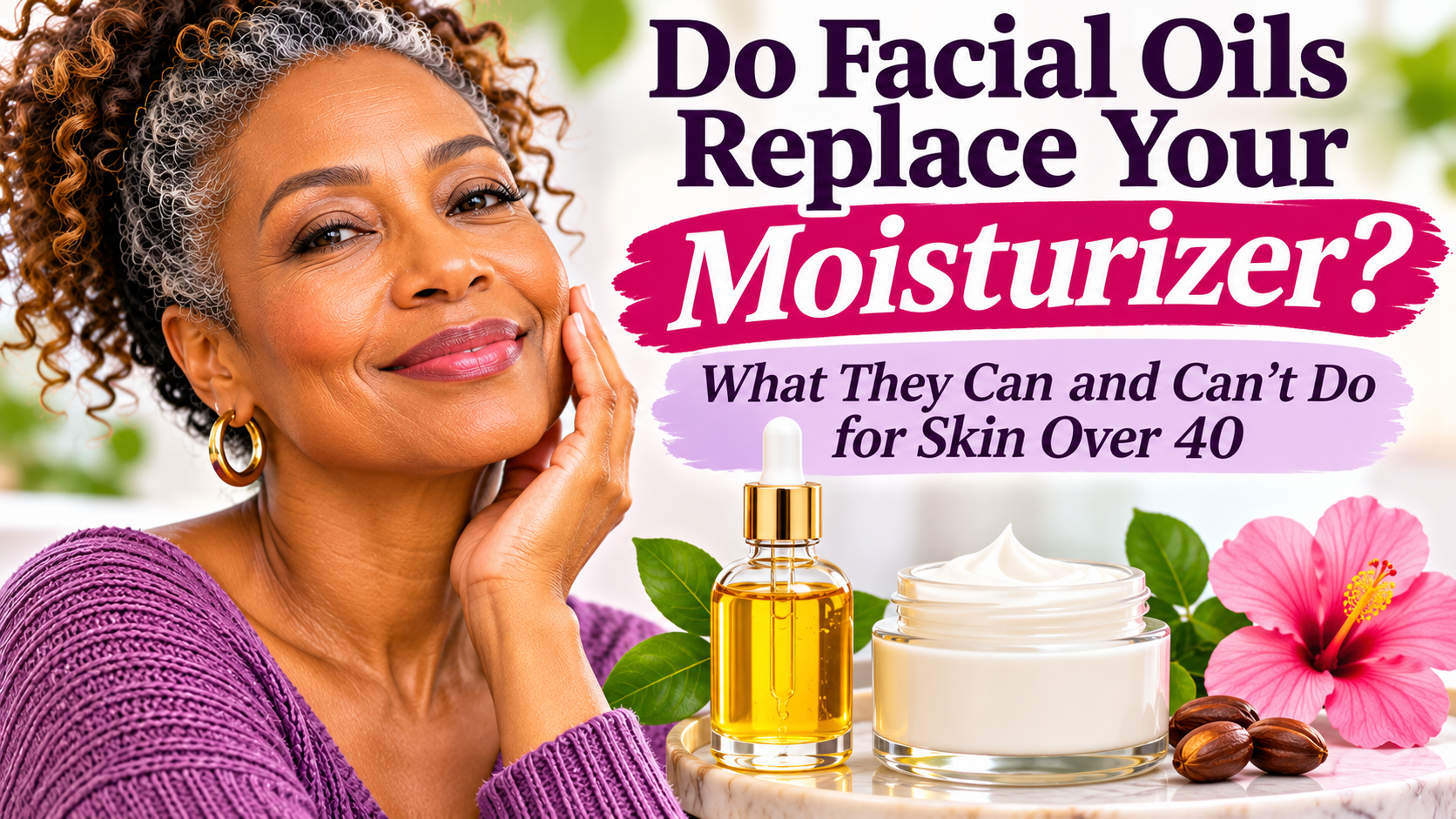
Your facial oil makes your skin feel soft, smooth, and glowing. But is it actually moisturizing your skin—or just making it feel moisturized?
If you’re over 40 and dealing with dryness, tightness, or changing skin texture, understanding the difference could save you money and frustration.

Let’s talk about something that confuses a lot of women when it comes to skincare.
Facial oils.
Jojoba oil. Rosehip oil. Argan oil. Squalane.
Everywhere you look, somebody is recommending another oil that supposedly makes your skin look younger, smoother, and more hydrated.
And if you’ve ever applied a few drops to your face, you know how nice it can feel.
Your skin looks glowy.
It feels soft.
Sometimes those dry patches seem to disappear almost immediately.
So naturally, you start wondering:
Why am I buying moisturizer when I already have this facial oil?
Well, here’s where things get interesting.
Facial oils can help your skin, but they don’t always do the same job as a well-formulated moisturizer.
And understanding that difference matters even more as your skin changes with age.
Facial oils can soften skin and help reduce moisture loss. But many oils don’t supply the water-binding ingredients or complete barrier-supporting formula found in a good moisturizer. For dry mature skin, using moisturizer first and oil afterward may work better than relying on oil alone.
1. Why Your Skin May Feel Drier After 40
If your skin suddenly feels different in your 40s or 50s, you’re not imagining it.
As we age, several changes can affect how well our skin holds onto moisture.
These include changes in the skin barrier, natural oil production, and the structure of the skin itself.
For women experiencing perimenopause or menopause, declining estrogen may also contribute to dryness and changes in skin elasticity.
That’s why your old skincare routine may not feel as effective anymore.
You might notice:
- Your face feels tight after washing.
- Fine lines appear more noticeable when your skin is dry.
- Your moisturizer seems to disappear quickly.
- Your skin looks dull or rough.
- Makeup settles into dry areas.
- Your cheeks feel dry while your forehead still gets oily.
But here’s something important.
Dry skin isn’t always a sign that you need more oil.
Sometimes your skin needs ingredients that attract and retain water, plus ingredients that help support the skin barrier.
For more information, read our article about how menopause affects your skin .
2. Hydration, Moisturizing, and Sealing: What’s the Difference?
These terms are often used interchangeably in beauty advertisements, but they describe different functions.
Hydration
Hydration refers to water content in the skin.
Ingredients called humectants, such as glycerin and hyaluronic acid, help attract and retain water.
Softening
Ingredients called emollients smooth and soften the skin’s surface.
Many facial oils work primarily as emollients.
Reducing Moisture Loss
Occlusive ingredients help reduce water escaping from the skin.
Some oils can contribute to this effect, although their performance varies.
Complete Moisturizing
A well-formulated moisturizer may combine humectants, emollients, and occlusives to address several skin needs at once.
Think about it this way.
If your skin needs water-binding ingredients, applying oil alone may not solve the problem.
The oil may make your face feel softer without providing the full combination of ingredients your skin needs.
And that’s why a facial oil and a moisturizer aren’t always interchangeable.
3. What Facial Oils Can Actually Do for Mature Skin
Now, don’t misunderstand me.
Facial oils aren’t useless.
Some can be helpful additions to a skincare routine.
Depending on the oil and its formulation, potential benefits include:
- Softening rough or flaky skin.
- Improving the appearance of dryness.
- Helping reduce moisture loss.
- Making the skin surface feel smoother.
- Adding a temporary dewy appearance.
Some plant oils also contain fatty acids and other compounds that have been studied for their effects on skin.
But these benefits vary by ingredient and formulation.
And just because an oil contains antioxidants doesn’t mean it has been proven to reverse wrinkles or stimulate collagen production in humans.
They cannot replace sunscreen, reverse menopause-related skin changes, eliminate deep wrinkles, or guarantee treatment of eczema, rosacea, or acne. They also cannot automatically replace every function of a moisturizer.

4. Facial Oil vs. Moisturizer: Which Does What?
| Skin Concern | Facial Oil | Moisturizer |
|---|---|---|
| Dry, rough texture | Can soften and smooth | Can soften while also supplying water-binding ingredients |
| Dehydrated skin | May help limit moisture loss | Often contains humectants that help retain water |
| Skin barrier support | Depends on the oil | May contain ceramides, fatty acids, and other barrier-supporting ingredients |
| Fine lines caused by dryness | May temporarily soften their appearance | May temporarily plump their appearance through hydration |
| Very sensitive skin | Some oils may irritate | Fragrance-free barrier-focused formulas are often a practical starting point |
| Daily sun protection | Not a sunscreen replacement | Only protects against UV if specifically labeled with adequate broad-spectrum SPF |
So which one wins?
For most women dealing with persistent dryness, a well-formulated moisturizer is the better foundation.
A facial oil can be an optional extra.
But if your current moisturizer already leaves your skin comfortable, you may not need an oil at all.
5. Popular Facial Oils: Which Ones Are Worth Considering?
Not every facial oil behaves the same way.
Some are lightweight.
Others feel richer or heavier.
And some are more likely to cause irritation, particularly if they contain fragrance or essential oils.
Squalane: A Lightweight Option
Squalane is a stable, lightweight emollient used in many skincare products.
It can help skin feel smoother and softer without the heavy feel of some richer oils.
It may be worth considering if you dislike greasy textures.
Best fit: Someone who wants a simple, lightweight finishing product.
Keep in mind: It doesn’t automatically replace a moisturizer containing humectants and barrier-supporting ingredients.
Jojoba Oil: A Versatile Emollient
Jojoba oil is technically a liquid wax ester rather than a typical triglyceride oil.
It’s commonly used in skincare because of its emollient properties.
It may help soften dry skin and improve how the skin surface feels.
Best fit: Someone looking for a straightforward emollient and who tolerates plant-derived ingredients.
Keep in mind: It can still cause reactions in some people, so patch testing matters.
Rosehip Oil: Popular for Mature Skin
Rosehip seed oil contains fatty acids and is popular in products marketed for mature skin.
It may help soften the skin, but strong clinical evidence for dramatic wrinkle reduction or scar removal from ordinary rosehip oil is limited.
Best fit: Someone who enjoys botanical oils and wants an additional emollient.
Keep in mind: Don’t confuse rosehip oil with prescription retinoids or assume they’re interchangeable.
Argan Oil: A Richer Skin-Softening Option
Argan oil is rich in lipids and is commonly used in skin and hair products.
It may improve skin softness and comfort.
However, evidence is limited for many of the dramatic anti-aging claims made about it.
Best fit: Someone who prefers a richer-feeling emollient.
Keep in mind: The right texture depends on your skin, climate, and personal preference.
What About Coconut Oil?
Coconut oil can act as an emollient and help reduce moisture loss.
But it may feel heavy and can contribute to clogged pores in some acne-prone individuals.
It isn’t my first recommendation for someone who frequently develops facial breakouts.
And if you have rosacea, eczema, or very reactive skin, avoid experimenting with multiple oils without guidance.
6. Which Should You Use for Your Skin Type?
Here’s a practical guide.
Start with a fragrance-free moisturizer containing humectants and barrier-supporting ingredients. Add a small amount of facial oil afterward only if you need extra softness.
Choose a lightweight moisturizer first. You may not need a separate oil, especially if heavier products leave you feeling greasy.
Keep the ingredient list simple. Avoid strongly fragranced oils and essential oils. Patch test anything new.
Look for noncomedogenic moisturizers and introduce oils cautiously. Some people find heavier oils worsen breakouts.
Focus on gentle, fragrance-free skincare. If redness or burning is persistent, consult a dermatologist before adding botanical oils.
Don’t buy a facial oil just because it’s trending. Your existing moisturizer may be doing everything you need.
7. Should Facial Oil Go Before or After Moisturizer?
This is one of the most common questions about facial oils.
And the answer is simpler than some skincare influencers make it sound.
For many routines, applying moisturizer first and a few drops of oil afterward is a reasonable approach.
Why?
Your moisturizer may contain water-binding ingredients, while the oil can provide additional softening and help reduce moisture loss.
However, some products are specifically formulated to be applied in a different order.
Always follow the directions for the products you’re using.
A Simple Morning Routine After 40
Use a mild cleanser or rinse with lukewarm water if that works better for your dry skin.
Apply a moisturizer suited to your skin type. Ingredients such as glycerin, ceramides, and hyaluronic acid may be helpful.
Finish with broad-spectrum SPF 30 or higher. Apply enough to exposed skin and reapply as directed when outdoors.
Important: If you use facial oil in the morning, avoid layering it over sunscreen or mixing it into sunscreen, since that may interfere with the product’s protective film. The simplest approach is to leave facial oil for your evening routine.
A Simple Evening Routine
Remove makeup, sunscreen, and daily buildup with a gentle cleanser.
Apply your usual moisturizer while your skin is slightly damp, if appropriate for the product.
If your skin still feels dry, gently apply a small amount of facial oil as a finishing step.
If you’re using prescription skincare treatments or retinoids, follow the application order recommended by your dermatologist.
8. Five Mistakes That Can Make Facial Oils Less Helpful
Even a good facial oil can disappoint when used incorrectly.
Mistake 1: Using Oil Instead of Every Other Skincare Product
Facial oil isn’t a complete skincare routine.
It doesn’t replace cleansing, sun protection, or medically necessary treatment.
Mistake 2: Applying More and More Oil to Dehydrated Skin
If your skin lacks water-binding support, adding extra oil may leave it greasy without resolving the underlying dryness.
Mistake 3: Assuming Natural Means Safe
Essential oils and botanical extracts can cause irritation or allergic contact dermatitis.
Natural ingredients deserve the same caution as synthetic ones.
Mistake 4: Expecting Facial Oil to Erase Wrinkles
Oils can temporarily improve the appearance of dry fine lines by softening the skin.
But they aren’t proven replacements for evidence-based treatments addressing photoaging.
Mistake 5: Buying Several Oils at Once
If your skin reacts, how will you know which product caused it?
Introduce one new product at a time and give your skin a chance to adjust.
9. How to Shop for Facial Oils Without Wasting Money
Before purchasing, check the ingredient list.
Look for:
- A clearly identified oil or emollient.
- Minimal unnecessary fragrance.
- Packaging appropriate for the formulation.
- Clear usage directions.
- A price that makes sense for how often you’ll use it.
Be cautious with claims such as:
- “Reverses 20 years of aging.”
- “Rebuilds all lost collagen overnight.”
- “Replaces every moisturizer.”
- “Works for absolutely every skin type.”
Those are marketing promises, not reliable evidence of performance.
And remember, a facial oil doesn’t have to be expensive to be useful.
If you’re deciding between buying a good moisturizer or an expensive facial oil, prioritize the moisturizer first.
Then consider adding a simple oil if you still need extra comfort or softness.
10. Facial Oil vs. Moisturizer: The Final Verdict
So, do facial oils replace your moisturizer after 40?
Usually, no—not if your skin needs the broader benefits of a well-formulated moisturizer.
Facial oils can soften skin, improve its feel, and help reduce moisture loss.
But they may not provide the water-binding ingredients or complete combination of barrier-supporting ingredients your skin needs.
And the older we get, the more important it becomes to pay attention to what our skin actually needs instead of following every new beauty trend.
If your skin is dry, start with a gentle moisturizer.
If it still needs extra comfort, consider adding a facial oil.
And if your skin already looks and feels healthy, don’t complicate your routine just because somebody on social media has a 12-step skincare ritual.
Healthy skin doesn’t have to be complicated—or expensive.
Because Beauty Never Fades.

Keep Your Skincare Simple
You don’t need every oil on the shelf to care for mature skin.
Start with a gentle cleanser, a moisturizer that keeps your skin comfortable, and daily sunscreen.
Then add a facial oil only if your skin benefits from it.
For more help choosing products, explore our skincare guides below.
Frequently Asked Questions
Can I use facial oil instead of moisturizer?
Some people may find an oil sufficient for their personal needs, but many facial oils don’t provide the full range of water-binding and barrier-supporting ingredients found in a good moisturizer.
Which facial oil is best for skin over 40?
There is no single best oil for everyone. Squalane, jojoba, rosehip, and argan are common options, but the best choice depends on your skin type and tolerance.
Should I put facial oil on before or after moisturizer?
Applying it after moisturizer is a practical option for many routines, although product directions may differ.
Can facial oils help wrinkles?
They may temporarily soften the appearance of fine lines caused by dryness, but they aren’t proven to eliminate deep wrinkles.
Are facial oils good for menopausal skin?
They may help with softness and moisture retention, but menopausal skin often benefits from a broader skincare routine that includes moisturizer and sunscreen.
Sources and Further Reading
- American Academy of Dermatology: Moisturizing Dry Skin
- American Academy of Dermatology: Dermatologists’ Tips for Relieving Dry Skin
- Anti-Inflammatory and Skin Barrier Repair Effects of Topical Plant Oils
- American Academy of Dermatology: Sunscreen Guidance
Disclaimer: This article is for educational purposes only and is not a substitute for individualized medical advice. If you have eczema, rosacea, persistent irritation, or other skin conditions, consult a qualified healthcare professional before introducing new skincare products.